

The Bachelor of Pharmacy, or B.Pharma, is a foundational four-year undergraduate program that acts as the gateway to the vast world of pharmaceutical sciences. It is a blend of biology, chemistry, and healthcare, designed to transform students into experts who understand how drugs interact with the human body, how they are manufactured, and how they are regulated to ensure public safety.
In a rapidly evolving global healthcare landscape, the B.Pharma degree has moved beyond the traditional image of a local chemist. It is now a high-tech, research-driven discipline central to drug discovery, vaccine development, and personalized medicine.
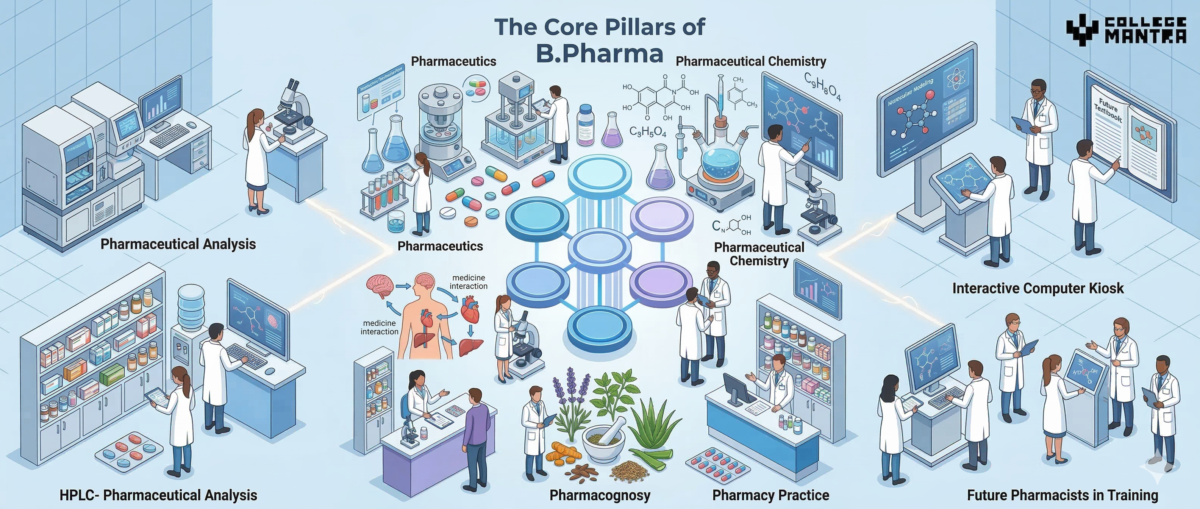
The Core Pillars of B.Pharma
The curriculum of a B.Pharma program is meticulously structured to cover every aspect of a drug’s lifecycle—from its chemical synthesis in a lab to its metabolic journey through a patient’s bloodstream.
1. Pharmaceutics: The Art of Formulation
This is the study of turning a pure drug chemical into a safe and effective medicine (like a tablet, capsule, or injection). Students learn about “drug delivery systems”—how to ensure a pill dissolves at the right time and targets the right organ.
2. Pharmaceutical Chemistry
This involves the study of drug design and synthesis. Students use organic and inorganic chemistry to understand molecular structures. If Pharmaceutics is about the “package,” Pharmaceutical Chemistry is about the “engine” of the medicine.
3. Pharmacology: How Drugs Work
Pharmacology is perhaps the most exciting branch for many. It explores the “pharmacodynamics” (what the drug does to the body) and “pharmacokinetics” (what the body does to the drug). This knowledge is crucial for predicting side effects and determining correct dosages.
4. Pharmacognosy: Nature’s Pharmacy
Before synthetic labs existed, medicines came from plants and animals. Pharmacognosy is the study of medicines derived from natural sources. With the modern resurgence of herbal and “nutraceutical” products, this field is more relevant than ever.
Life in the Lab: The Practical Experience
As seen in the professional laboratory environment, B.Pharma is a hands-on degree. Students spend a significant portion of their time in modern pharmaceutical research labs.
Analysis: Using advanced tools like microscopes and HPLC (High-Performance Liquid Chromatography) to test the purity of chemical compounds.
Synthesis: Creating chemical reactions to develop new medicinal molecules.
Testing: Simulating how a tablet dissolves in the stomach using dissolution apparatus.
The environment is one of precision. Every milligram counts, and students are trained in Good Manufacturing Practices (GMP) and Good Laboratory Practices (GLP) to meet international healthcare standards.
Career Horizons: Where Can B.Pharma Take You?
The versatility of a B.Pharma degree is one of its greatest strengths. Graduates aren’t limited to a single path; they can choose from several distinct sectors:
Industrial Pharmacy and Manufacturing
This is the “engine room” of the industry. Graduates work in large-scale production units, ensuring that millions of doses of medicine are produced with 100% consistency. Roles include Production Manager, Quality Control (QC) Analyst, and Quality Assurance (QA) Specialist.
Research and Development (R&D)
For those with a scientific itch, R&D is where the magic happens. This involves discovering new drug molecules or improving existing ones. While many R&D roles eventually require a Master’s (M.Pharma) or PhD, a B.Pharma degree is the essential starting point.
Regulatory Affairs
Every drug must be approved by government bodies (like the FDA in the US or the CDSCO in India). Regulatory experts act as the bridge between the pharmaceutical company and the government, ensuring all legal and safety protocols are followed.
Clinical Research
Before a drug hits the market, it must be tested on humans. Clinical Research Associates (CRAs) monitor these trials to ensure they are ethical and that the data collected is accurate.
Community and Hospital Pharmacy
The most visible face of the profession. Hospital pharmacists work closely with doctors to manage patient medication charts, while community pharmacists provide essential healthcare advice and life-saving medications to the public.
Why Choose B.Pharma Today?
The COVID-19 pandemic served as a global wake-up call regarding the importance of pharmacists. From the rapid development of vaccines to the management of global supply chains for essential medicines, the pharmaceutical sector proved to be the backbone of global resilience.
Global Demand: The pharmaceutical industry is “recession-proof.” People will always need medicine, making this one of the most stable career paths.
Technological Integration: Modern pharmacy is embracing AI for drug discovery and 3D printing for personalized pills. A B.Pharma student today is at the intersection of healthcare and cutting-edge tech.
Contribution to Society: There is a deep sense of purpose in knowing that your work—whether in a lab or a clinic—directly saves lives and alleviates suffering.
Skills Required for Success
To excel in B.Pharma, a student needs more than just an interest in science. Key traits include:
Analytical Thinking: The ability to interpret complex data and chemical structures.
Precision and Accuracy: In pharmacy, a decimal point in the wrong place can be dangerous.
Ethics: Since you are dealing with human life, integrity is the most important “ingredient.”
Continuous Learning: Medicine changes every day; a pharmacist must be a student for life.
Conclusion
A Bachelor of Pharmacy is much more than a degree; it is a commitment to the science of healing. It offers a unique blend of corporate opportunities, research potential, and clinical service. Whether you aspire to discover the next breakthrough cure in a high-tech lab or ensure the safety of patients in a hospital, B.Pharma provides the tools, knowledge, and professional standing to make it happen.
As you embark on this journey with College Mantra, you are entering a field that is as challenging as it is rewarding—a field where science meets service.