

Choosing the right path after 12th grade is a pivotal decision that sets the trajectory for your professional life. For students with a foundational interest in science and a drive for analytical thinking, the Bachelor of Science (B.Sc.) remains one of the most versatile and intellectually rewarding undergraduate degrees available.
What is a B.Sc. Course?
A Bachelor of Science (B.Sc.) is a three to four-year undergraduate degree designed to provide students with a deep, theoretical, and practical understanding of scientific principles. Unlike professional degrees that focus strictly on a specific job role, a B.Sc. emphasizes the “why” and “how” behind natural phenomena, mathematical structures, and technological systems.
The curriculum is generally split into two main categories:
B.Sc. General (Pass Course): This provides a broad foundation across multiple subjects like Physics, Chemistry, and Mathematics (PCM) or Botany, Zoology, and Chemistry (BZC). It is ideal for students who want a well-rounded scientific education before narrowing their focus in post-graduation.
B.Sc. Honors: This allows for deep specialization in a single subject, such as B.Sc. Physics, B.Sc. Agriculture, or B.Sc. Computer Science. It involves rigorous research projects and advanced coursework, making it a preferred choice for those aiming for academia or specialized industry roles.
The Benefits of Choosing B.Sc. After 12th
The modern job market values adaptability and technical literacy—two pillars of a B.Sc. education. Here is why choosing this path can be a strategic move:
1. Vast Range of Specializations
One of the greatest strengths of a B.Sc. is its diversity. Students aren’t limited to traditional subjects. You can choose niche, high-growth fields such as:
Data Science and AI: Merging mathematics with modern computing.
Biotechnology: Combining biology with technology for healthcare and agriculture.
Aviation: For those looking into the technical side of the aerospace industry.
Forensic Science: Applying scientific methods to legal investigations.
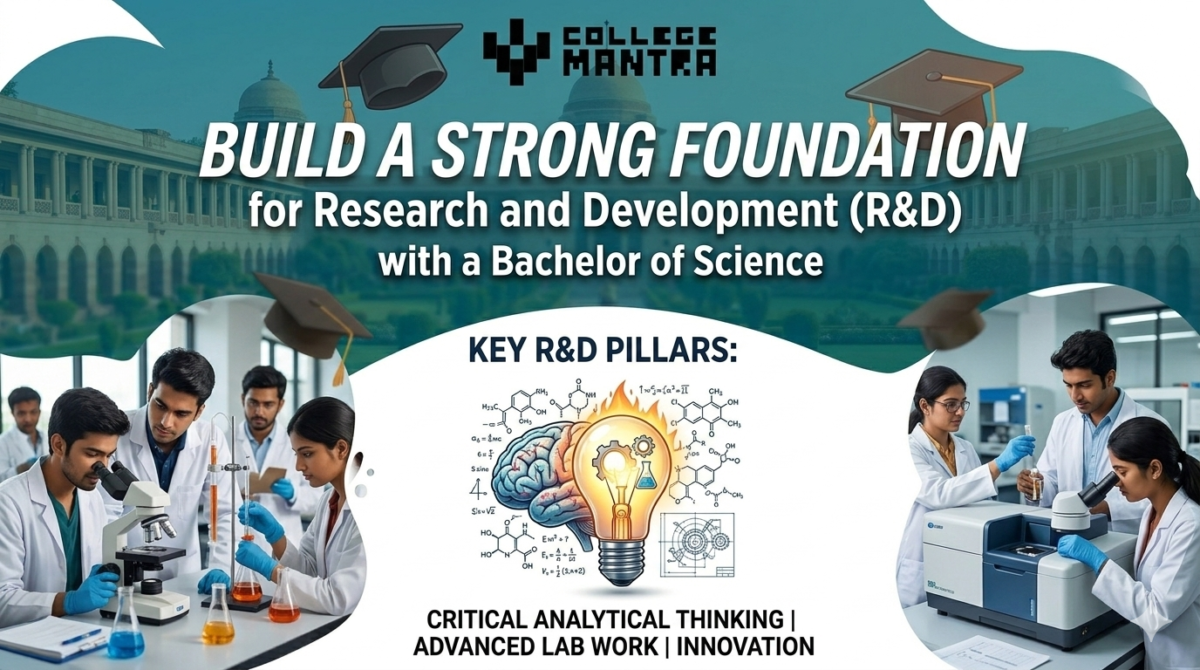
2. Strong Foundation for Research and Development (R&D)
If you are someone who asks “What if?” a B.Sc. is your gateway. It is the primary pathway for careers in research. India and the global community are investing heavily in R&D to tackle climate change, pandemics, and renewable energy. Organizations like ISRO, DRDO, and various pharmaceutical giants prioritize B.Sc. and M.Sc. graduates for their analytical rigor.
3. Career Flexibility and Higher Education
A B.Sc. degree is a “stepping stone” degree. Because it builds strong logical and mathematical skills, graduates aren’t confined to science alone.
MBA: Many B.Sc. graduates transition into management, where their data-driven mindset is highly valued.
MCA: B.Sc. Computer Science or IT graduates can easily pivot into advanced software engineering.
Civil Services: Science graduates historically perform well in exams like the UPSC, as the discipline required for science translates well to the vast syllabus of competitive exams.
4. Competitive Salary and Job Security
With the rise of “Deep Tech” and the “Green Economy,” specialized science graduates are in high demand. For instance, a B.Sc. in Agriculture graduate is vital for the evolving agritech sector, while a B.Sc. Nursing or Medical Lab Technology graduate enters a recession-proof healthcare industry. Salaries for specialized roles often rival those in engineering and commerce.
Skills You Gain
A B.Sc. isn’t just about memorizing formulas; it’s about developing a specific mental toolkit:
Analytical Reasoning: Learning to break down complex problems into smaller, manageable parts.
Technical Proficiency: Gaining hands-on experience in laboratories and with specialized software.
Statistical Literacy: Understanding data, which is the “new oil” in the 21st-century economy.
Comparison: B.Sc. vs. Professional Courses
While B.Tech or MBBS are highly structured toward specific professions, a B.Sc. offers a “buffer” period. It allows you to explore your interests deeply before committing to a lifelong career path. It is often more cost-effective than private engineering or medical degrees, offering a high Return on Investment (ROI) when followed by a focused Master’s degree.
Conclusion
Choosing a B.Sc. after 12th is an investment in your ability to learn and adapt. Whether you want to discover the next life-saving vaccine, manage a massive IT infrastructure, or lead a corporate boardroom, the scientific temper developed during these three or four years provides a robust foundation.
The world is moving toward interdisciplinary solutions, and a B.Sc. graduate stands at the intersection of curiosity and capability. If you have a passion for discovery and a drive for logical excellence, this course is the perfect launchpad for your future.