
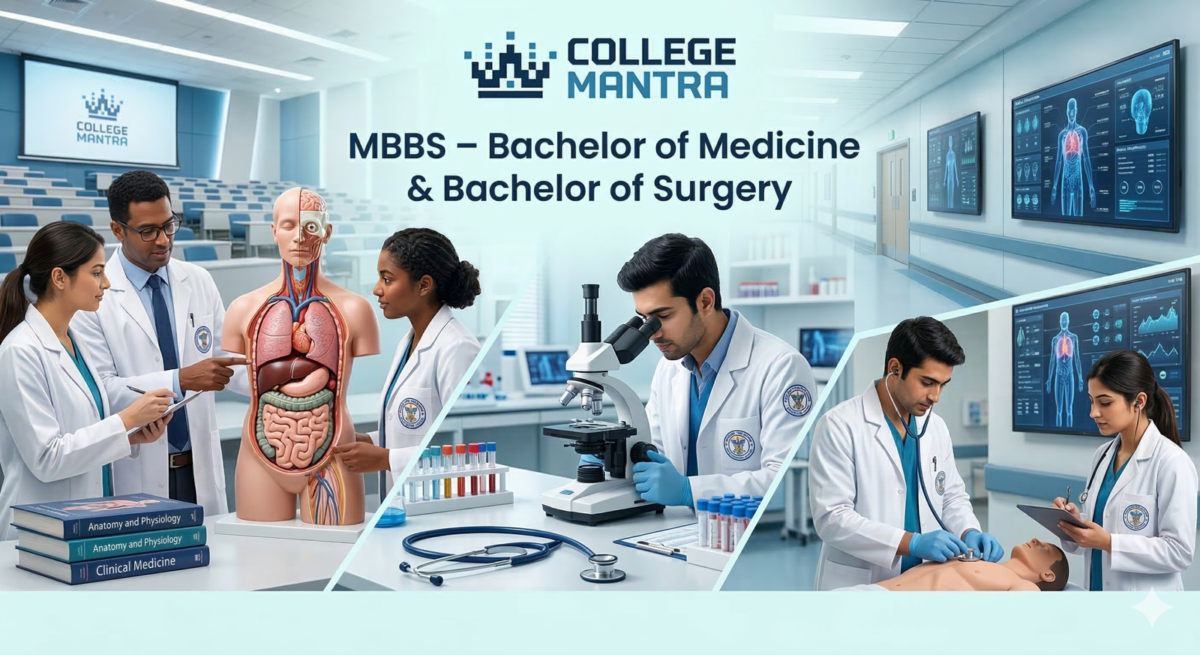
The Bachelor of Medicine and Bachelor of Surgery, or MBBS, remains one of the most prestigious and sought-after undergraduate degrees in the world. For many, it is not just a career choice but a lifelong commitment to service, science, and the art of healing. This comprehensive guide explores the journey of an MBBS student, the academic rigors involved, and the vast professional landscape that follows graduation.
1. Understanding the Degree
The MBBS is a professional undergraduate degree that prepares students to practice medicine and surgery. While the acronym suggests two separate degrees, they are awarded together as a single qualification in most Commonwealth countries, including India.
Duration: The program typically spans 5.5 years.
Structure: This includes 4.5 years of academic study divided into professional phases and a 1-year mandatory rotatory internship.
Core Objective: The curriculum is designed to transform high school graduates into “Indian Medical Graduates” (IMGs) who possess the knowledge, skills, and compassionate attitude required to serve as the first point of contact for patients.
2. The Academic Journey: Phase by Phase
The MBBS curriculum is famously rigorous, blending deep theoretical knowledge with hands-on clinical training.
Phase I: Pre-Clinical (The Foundation)
In the first year, students focus on the “normal” human body.
Anatomy: The study of the human structure through cadaveric dissection.
Physiology: Understanding how organ systems function.
Biochemistry: The chemical processes within and relating to living organisms.
Phase II: Para-Clinical (Understanding Disease)
Students begin to bridge the gap between basic science and clinical practice.
Pathology: The study of the nature and causes of diseases.
Microbiology: Learning about infectious agents like bacteria, viruses, and fungi.
Pharmacology: The science of drugs and their effects on the human body.
Forensic Medicine: The application of medical knowledge to legal issues.
Phase III: Clinical (The Art of Healing)
The final years are spent primarily in hospital wards. Students rotate through various specialties to gain diverse exposure:
Community Medicine: Focusing on public health and rural healthcare.
General Medicine & Pediatrics: Managing adult and childhood illnesses.
Surgery: Learning the fundamentals of operative care.
Obstetrics & Gynecology: Specialized care for women and childbirth.
3. The Mandatory Internship
The one-year rotatory internship is perhaps the most critical part of the MBBS journey. It is during this time that a student officially becomes a “Doctor” (intern).
Responsibility: Interns work under supervision in various departments like the Emergency Room (ER), Intensive Care Unit (ICU), and outpatient clinics.
Skills: They learn essential procedures such as drawing blood, suturing wounds, and assisting in surgeries.
Stipend: Most government and some private colleges provide a monthly stipend during this period.

4. Skills Required for Success
Beyond academic brilliance, a successful medical student must cultivate specific “soft” skills:
Resilience: The ability to handle long hours and high-pressure environments.
Empathy: Understanding the patient’s perspective is as important as the diagnosis.
Communication: Explaining complex medical conditions to patients and their families.
Continuous Learning: Medicine evolves daily; a doctor must remain a student for life.
5. Career Paths After MBBS
Graduating with an MBBS degree is just the beginning. The medical field offers a variety of specialized paths:
A. Post-Graduation (MD/MS)
Most graduates choose to specialize further by appearing for competitive exams like NEET-PG or NEXT.
MD (Doctor of Medicine): For non-surgical specialties like Internal Medicine, Radiology, or Dermatology.
MS (Master of Surgery): For surgical fields like Orthopedics, ENT, or General Surgery.
B. Civil Services
Many doctors opt for the UPSC (Union Public Service Commission) to enter administrative roles, where they can influence healthcare policy at a national level.
C. Combined Medical Services (CMS)
Working for the government in organizations like the Railways, Municipal Corporations, or the Ordnance Factories Health Service.
D. Hospital Administration
Doctors with an interest in management can pursue an MBA in Hospital Management or a Master in Health Administration (MHA) to lead large healthcare facilities.
E. Clinical Research & Academics
For those who love the “why” behind the “how,” careers in medical research or teaching in medical colleges are highly rewarding.
6. Why Choose MBBS?
Job Security: There is a global shortage of healthcare professionals, ensuring constant demand.
Social Impact: It is one of the few professions where you can directly impact and save lives daily.
Diverse Opportunities: From rural clinics to high-tech urban research labs, the choice of environment is yours.
7. Conclusion
The path to an MBBS degree is long, challenging, and requires immense dedication. However, the reward—the ability to alleviate human suffering—is unparalleled. For students at College Mantra, the journey into medicine is supported by a foundation of expert faculty and advanced clinical training. Whether you aspire to be a surgeon, a researcher, or a public health advocate, the MBBS degree is your gateway to a world of endless possibilities.