
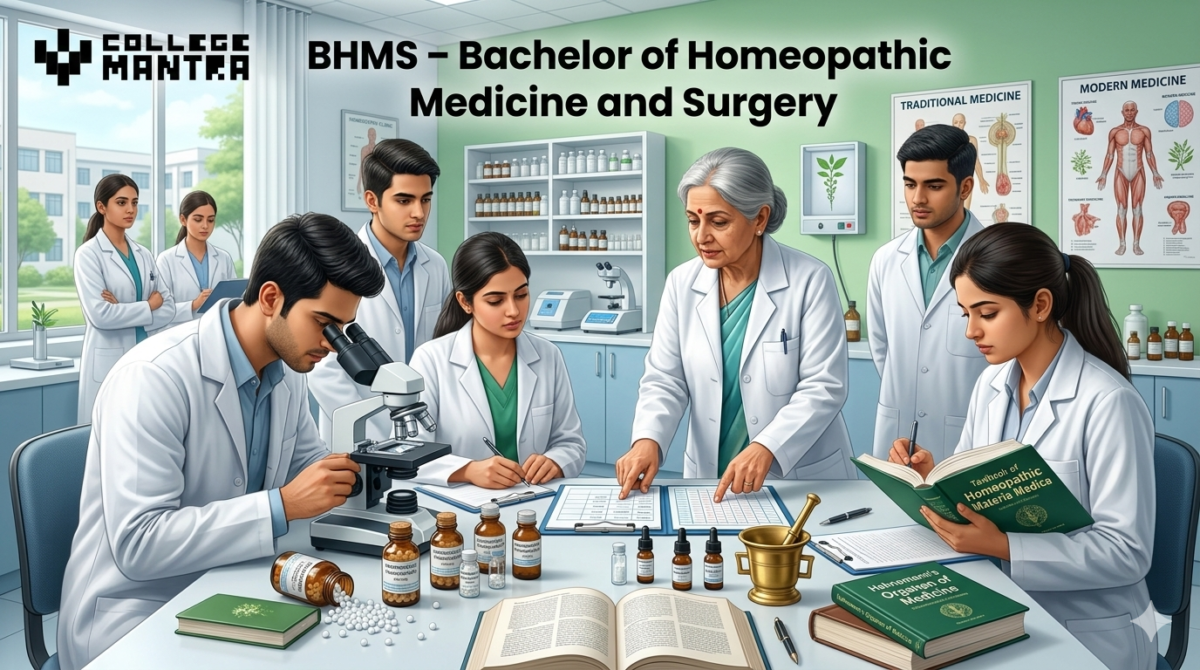
The Bachelor of Homeopathic Medicine and Surgery (BHMS) is a professional undergraduate degree that focuses on the homeopathic system of medicine. Rooted in the principle of “Similia Similibus Curentur” (let likes be cured by likes), BHMS prepares students to become holistic healers who treat the individual as a whole—integrating the mind, body, and spirit.
What is BHMS?
BHMS is a 5.5-year medical program regulated by the National Commission for Homoeopathy (NCH). It combines traditional homeopathic principles with modern medical subjects like Anatomy, Physiology, and Surgery.
The course structure is divided into:
4.5 Years of academic study.
1 Year of compulsory rotatory internship in a clinical setting.
The Academic Journey: Year by Year
Year 1: The Building Blocks
The first year introduces the student to the human body and the philosophy of homeopathy.
Anatomy & Physiology: Extensive study of the human structure and its functions, identical to the curriculum in other medical streams.
Homeopathic Pharmacy: Learning how remedies are prepared from natural sources (plants, minerals, and animals) through the process of potentization.
Organon of Medicine: The foundational philosophy and principles of homeopathy as laid down by Dr. Samuel Hahnemann.
Year 2: Understanding Disease
The focus shifts toward how health is disrupted and how remedies are categorized.
Pathology & Microbiology: Studying the nature of diseases and the microorganisms that cause them.
Forensic Medicine & Toxicology: Legal aspects of medicine and the study of poisons.
Homeopathic Materia Medica: The study of individual remedies and the specific symptoms they can cure.
Year 3: Clinical Fundamentals
This is when students begin observing patients and learning the art of case-taking.
Surgery: Learning surgical procedures and diagnosis, though homeopathic treatment is often used to manage post-surgical recovery or avoid surgery in specific cases.
Obstetrics & Gynecology: Specialized care for women’s health and childbirth.
Homeopathic Therapeutics: Learning how to apply homeopathic remedies to specific clinical conditions.
Year 4: Advanced Specialization
The final academic year prepares students for full-scale practice.
Practice of Medicine: Detailed study of internal medicine and systemic diseases.
Community Medicine: Public health, hygiene, and preventive care.
Repertory: Learning the use of “Repertories” (specialized indexes of symptoms) to find the most accurate remedy for a patient.
The Internship: Mastering the Art
The one-year internship is where students learn the “art of the small dose.” It involves rotating through OPDs and IPDs, observing chronic cases, and learning how to manage acute emergencies using homeopathic principles alongside modern diagnostic tools.
Career Paths: A Growing Field
1. Clinical Practice
Private Clinic: Most BHMS graduates establish their own practice. Homeopathy is highly sought after for chronic conditions like skin diseases, allergies, and autoimmune disorders.
Consultant: Working in multi-specialty clinics or homeopathic hospital chains.
2. Government Jobs
Medical Officer: Opportunities in government-run homeopathic hospitals and dispensaries under the Ministry of AYUSH.
Public Health: Involvement in rural health missions and community health programs.
3. Higher Education (MD in Homeopathy)
Graduates can specialize in fields such as:
Materia Medica
Repertory
Paediatrics
Psychiatry
Pharmacy

4. Research & Academia
Research Officer: Working with organizations like the Central Council for Research in Homoeopathy (CCRH).
Teaching: Becoming a lecturer or professor in homeopathic medical colleges.
5. Corporate Roles
Pharmaceuticals: Designing and manufacturing homeopathic medicines.
Wellness Industry: Working as medical consultants for wellness retreats and holistic health centers.
Essential Skills for BHMS Students
Acute Observation: Homeopathy relies on noticing subtle physical and emotional cues in a patient.
Communication: Case-taking is a deep dialogue; you must be an excellent listener.
Analytical Mind: Matching thousands of symptoms to a single remedy requires logical deduction.
Lifelong Learning: New remedies and research are constantly expanding the Materia Medica.
Pros and Cons of BHMS
| Pros | Cons |
| Holistic Healing: Treats the person, not just the disease. | Slow Perception: Some people mistakenly believe homeopathy is too slow for acute issues. |
| No Side Effects: Remedies are highly diluted and safe for all ages. | Intensive Study: Requires memorizing vast amounts of symptom data. |
| Rising Demand: Growing global preference for natural and non-invasive medicine. | Clinical Limits: Certain emergency or trauma cases still require conventional surgical intervention. |
Final Thoughts
BHMS is a path for those who believe in the body’s innate ability to heal itself. It is a rigorous medical degree that challenges you to look beyond the surface of a symptom to find the deep-seated cause of an illness. As the world moves toward integrated medicine, the role of a Homeopathic Doctor is more relevant than ever.